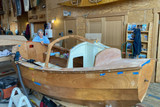
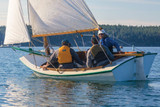
In the 24+ foot
range, there are not very many sets of wood-composite
(enhanced stitch-n-tape) boat plans available to the
home builder's market. The Great Alaskan series of
boats are at the same time seaworthy, efficient to
operate, trailerable in all 50 of the United States'
interstate roadway systems, yet still easy enough
to build that virtually anybody can do it - no fancy
set of tools required. We are not aware of any other
boats that combine all the features that this boat
does into a single vessel. All you need is a basic
set of sanders, a circular saw and/or a jig saw, and
a few hand tools ...no planer, no bandsaw, and no
router. If you can use a jig saw to cut plywood to
within 1/8" of a drawn line, then you can build
this boat.
Prince Rupert &
Newport Accommodations |
Basic Specifications:
* LOA: 26' (Buildable from 25' to 28')
* Bmax: 8' 5" (at amidships sheer deck)
* GMt: 48" to 52" (Depends on loading)
* Max. hull depth: 62"
* Draft: 12-1/2" (plus outboard & skeg)
* Deadrise aft: 13.1 degrees
* Half-angle of entry: 26 degrees
* Side flare: 15-17 degrees
* Hull weight: 2200# to 2700# depending on house/cabin
(hull and superstructure only)
* Normal displacement range: 3300# to 6000#, 3800#
typical
* Recommended power: 650# to 1050# (Approx. 150
hp to 200 hp, 160 hp being ideal)
* Recommended propulsion: Single or twin outboards
* Most efficient speed: 19 kts (22 mph)
* Maximum speed: 38 kts (44 mph)
* Fuel tankage: 120 gallons (typical)
* Expected fuel efficiency: 522 nautical miles
per 120 gallons of fuel
* Roomy cuddy, room for stand-up head, galley,
storage, and dining area
* Available in 3 models (1 primary hull design,
3 cuddy / pilot house combinations available,
instructions for 25' through 28' LOA)
Build sequence:
1. Assemble the building jig, a large
rectangular frame which carries molds and boat
during construction
2. Cut out and put together the bottom panel assembly
(bottom panel molds, bottom panels, chine flats)
and set aside
3. Build stem, main stringers (longitudinal beams),
sheer sub-decks, and transom
4. Assemble, with temporary framing and sheer
deck molds, the stem, sheer sub-decks, transom,
and stringers onto the building jig (boat upside
down)
5. Install bottom panel assembly onto stem, stringers,
and transom
6. Fit and install side panels
7. Turn boat upright and place back onto building
jig (carpeted cradles) or trailer
8. Add decks, cuddy, and pilot house
9. Finish and fit-out
10. Celebrate a launch!
This building procedure is slightly different than
what you will see being used for most wood/composite
boats. The advantage is that with the procedure above,
you can build a larger boat and do it with no special
jigs or lifting equipment ...other than a few friends
coming over for lunch once or twice. Let me explain.
Most wood/composite boats are built upright and have
bulkheads (etc) installed prior to turning the boat
upside down for exterior finish work. The boat is
already heavy before its first turning. Once the exterior
finish work is accomplished, the boat would be turned
back upright again and the interior superstructure
added and the boat finished. This means that you have
to turn a heavy boat once, and then a heavier boat
once. The building procedure above is more suitable
for larger boats. The bottom panel assembly is turned
over once, while it is still lightweight and has no
internal framing. Then later on, the boat hull is
turned once ..the last time that it needs to be turned,
but is lighter weight than what you'd have to turn
when using more traditional construction sequences.
When the hull is turned over, it has no internal bulkheads
or decking that add extra weight. The additional weight
of these internal components are not added to the
boat until it is upright for the last time. This and
the fact that you only need a very basic set of hand
tools to build this boat is what enables people to
build the boat without special equipment or experience.
Note: My compliments to Renn Tolman of the Tolman
Alaskan Skiff for the build procedure (used with his
permission of course.)
|