

Description
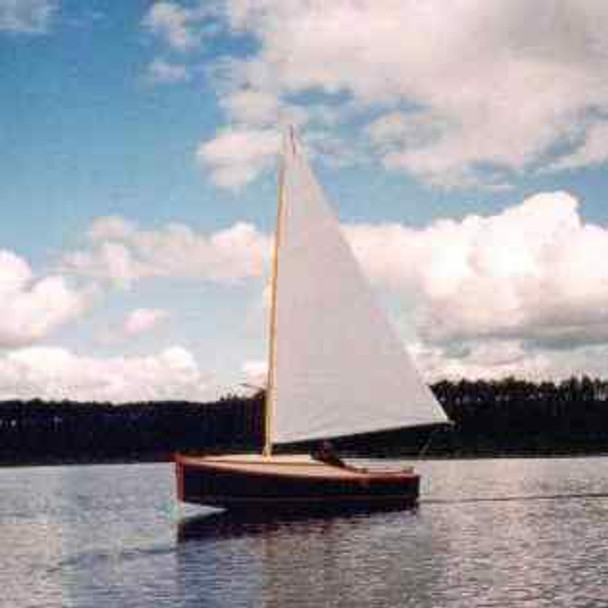
AF3 plans come with two sailplans: the original sharpie spritsail (as seen in the photo below) and a balanced lugsail option.

AF3, CUDDY SHARPIE, 16' X 5', 250 POUNDS EMPTY
The AF3 (the original design study was called "Alison's Fiddle") prototype was built by Herb McLeod of Edmonton, Alberta, with 70 hours of labor. He used spruce exterior plywood made at the plant he has to drive past on his way to the lumberyard.
The sail rig is the exact one I used on my old Bolger Jinni and it also found its way onto the Pencilbox design. I align the sail area directly above the trailing edge of the narrow leeboard on sharpies. If weather helm becomes a problem (hardly ever happens) you can dial it out by sweeping the leeboard aft. Traditional teaching would have the sail much farther forward but that guarantees lee helm in a boat like this. I'll bet the old rule about "lead" in sail layouts applies well to the sharp deep cutwater hulls of traditional planked boats.

Also I've shown external chine logs on AF3 and all my sharpies. They are an easy, quick, and strong bottom attachment, but many can't accept their looks. Use traditional interior logs if you wish. Better yet, use epoxy/fiberglass tape chine joints with a healthy interior radius. That makes for a really clean looking boat and the worst rot area in a wooden boat, that chine log, is totally eliminated.
AF3 is suitable for camping one person in its cabin and there is not a lot of room in there. If you would like a larger version of it try the 18'
Normsboat or the 20' AF2 that you can find in the online catalog.
AF3 uses six sheets of 1/4" plywood and two sheets of 1/2" plywood.
There are some other AF3's out there and I think I can include all the AF3's I know of. Herb's friend Gordon built this one:

Remember Frank SanMiguel in Colorado:

Pierre Yves Gabi built this one shown with the Swiss Alps in the background:

Max Wawrzyniak built this one in St. Louis:

AF3 uses six sheets of 1/4" plywood and two sheets of 1/2" plywood.
Additional Information
Measurement: |
Imperial |
Note: |
These files are from a preliminary scan and may be a little light but we think they are readable. In any case they will be replaced soon. |
Related Products

April Love Plans PDF
Irreducible Plans PDF

Oracle Plans PDF
