


Description
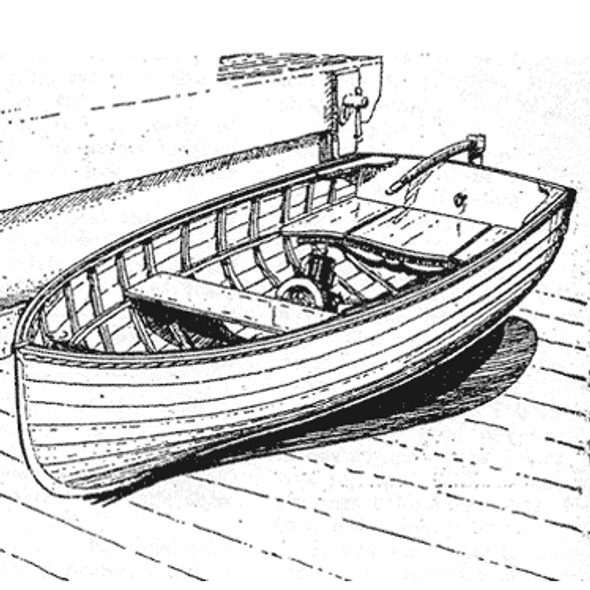
Don't remember where I read this but 100 years ago rowing was all the rage, the sort of thing you did on for fun. They said its popularity dropped and died after the invention of the modern "safety" bicycle which replaced it for athletic recreation. The Herreshoffs in Rhode Island had a historic boat business going at that time making everything from huge racing yachts to dinks to torpedo boats. L. Francis Herreshoff carried on the tradition in the 1900's being a great designer, artist and writer and educator. I suspect anything he wrote is worth seeking out. I have a copy of his book SENSIBLE CRUISING DESIGNS which I think is a compilation of articles he wrote for THE RUDDER magazine about 50 years ago. Lots of really good stuff in there. Among it is a discussion of good rowing boats with a "cartoon" presentation of a 17' rowing boat that would be fast and able but also simple and comfortable and not extreme. John Gardiner, another legend in small boats whose writings you should seek out, elaborated on that LFH cartoon and presented offsets for his idea of that boat in his BUILDING SMALL CLASSIC CRAFT, VOLUME 2. Both L. Francis and Gardner were used to traditional lapstake construction and thought nothing of presenting such a design. But the special lumber and tools needed for lapstrake are not common at least where I live. So I got an order for the LFH design redone for taped seam plywood. Thus the design I call the LFH17. As with L. Francis' original the LHF17 has a narrow flat bottom making it a dory of sorts and is identical bow and stern This boat will be a bit more complicated to build that most "instant" boats, I'm quite sure. For one thing it has three panels on each side to keep track of. And since they are long narrow pieces, all with a lot of flare, I doubt that it will jig itself like boats with wide plumb sides. So even though I show the expanded shapes of the individual planks I've also shown it made on a backbone or ladder frame so that it can be kept in proper alignment as it goes together. And, as with the original which probably had six or so strakes to each side instead of the three I show, the bottom bilge panel or garboard twists about fifty degrees in its journey from mid boat to stem and I would expect a fair amount of pushing and shoving required. LFH17 needs four sheets of 1/4" plywood with taped seam construction. |
FAST ROWBOAT, 17' X 3.5', 100 POUNDS EMPTY
Related Products

April Love Plans PDF
Irreducible Plans PDF

Oracle Plans PDF
