CABIN SAILBOAT, 18' X 5-1/2", 600 POUNDS EMPTY
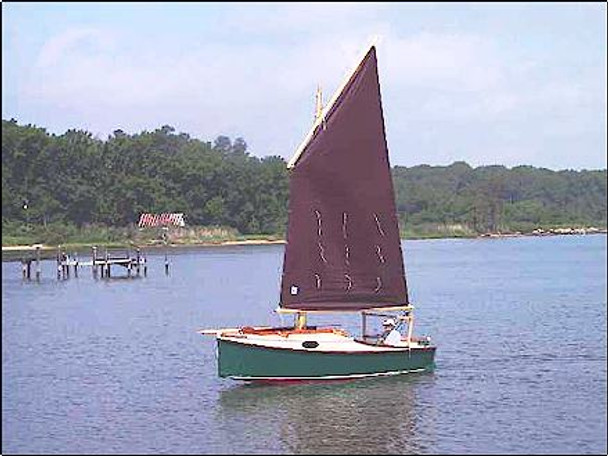
Normsboat was designed for Norm Wolf of Washington D.C. to join a group of trailer traveling shallow water sailors. He wanted the ability to motor and self rescue in a knockdown. Simplicity of rigging was also of importance. The prototype was built mostly by Richard Cullison with some items done by Norm.
A real motor mount is the first reality that you face with almost any boat that is supposed to be on a schedule. Normsboat has a very short motor well in the stern that is full width. Small fuel cans can go there too, as can the extra anchors, boots, etc. Actually Norm hasn't used the motoring ability of his boat (yet) and uses a 12' long yuloh oar instead which you can see lashed to the deck of his boat - it looks like a bow sprit but it isn't. I show oar ports on the drawings, another way of getting around without a motor in calm conditions. That, by the way, is the Achilles heel of the idea of using oars instead of a motor on a sailing boat. The oars will work in calm conditions but they can't save your butt in really bad going like a good motor might.
Just forward of the well is a buoyancy/storage chamber. Very important in a knockdown, a chamber like this is supposed to hold the stern up when the cockpit floods, keeping the boat level and preventing flooding in the cabin. Forward of that is a 6' long cockpit with bench seating giving Normsboat the capacity to sail several adults. Forward of that is a 7-1/2' cuddy cabin right out of AF4. It has a slot top which allows you to walk right to the bow of the boat. In bad weather you cover the slot with a tarp. There is room to sleep two but they have to be great chums, the idea is for it to be a solo cabin. And finally there is a small well in the bow for a messy anchor.

Norm did a practice capsize in calm conditions. It worked but I think most of us hoped the cabin slot would have more freeboard when the boat was on its side. I thought the AF3 capsize test went a lot better in that respect. I'm not sure why there is so much difference between the two. Anyway, I'm hoping for an AF2 practice capsize before making any decisions about it. Normsboat righted very easily when Norm grabbed the bottom and very little water inside the cockpit and none anywhere else. But I would be worried about a wave washing into the cabin slot in rough water and would make an effort to fit watertight hatches over the slot in rough going. I hope to write more about this in a later issue (if I figure it out).

The sail rig is right out of AF2 except here it is rigged as a balanced lug sail to make the rigging quicker. It also allows a lighter mast. On the downside, the mast must be stepped in the cabin but it won't be a bother to a solo cruiser. The boat could be rerigged as a gaffer as with AF2. Pivoting leeboard and rudder make sailing in shallows very easy.
Norm used to have a Dovekie. Phil Bolger, who designed Dovekie, would point out that the idea behind Dovekie was that it be non motorized and he would be disappointed that no one wants to row and everyone adds a motor. But almost every feature of Normsboat is something I learned from Bolger ..... the highly rockered sharpie hull, the double planked bottom (strength and weight where it is needed), the draining wells bow and stern, the emergency buoyancy system, the slot top cuddy, the lug sail with off center mounting, and the single pivoting leeboard.
Fourteen sheets of 3/8" plywood with simple nail and glue construction. No jigs, no lofting.