Description
For a Swaggie Study Plan download, click HERE
For Full Swaggie Plans in the form of a Digital Download, click HERE
Swaggie: (Australian slang) A tramp, or itinerant who carries his bedroll, or "Swag" upon his back.
My client loves small craft and has long had an ambition to cruise a very small cruiser that would be capable of blue water voyaging from his home on the Southern Coast of Australia. For those not familiar with the area that's roaring 40s territory and there are very long stretches of coast without shelter or refuge. In a storm the best option is to get as far out to sea as possible, close the hatch and get into your bunk but of course few very small cruisers are designed to survive this sort of treatment.
We'd corresponded about ideas for more than a while, and we seemed to have similar ideas if slightly different approaches so I drew a study proposal and sent it off to see what he thought.
Bingo, a cheque arrived by return! Hit the jackpot and rang the bell!
So here is Swaggie!
 (click to enlarge) |
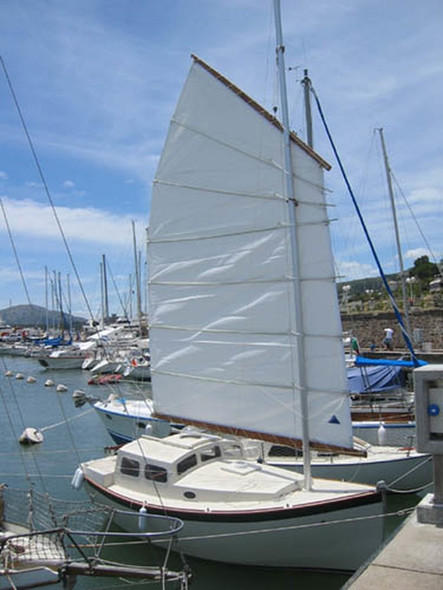
The basic premise of the boat is that she is sailed from inside. Her Junk rig is the key to this, the sail being able to be hoisted, reefed and sheeted from the main hatch means that a conventional cockpit and sail handling areas are not really required. This is a huge help as at less than 18 ft she is not big enough to have both a useful cockpit and a spacious cabin, seeing as she is a cruiser and needs to be comfortable the cabin is the priority.
Her accommodation is as follows:
Double bunk forward, sorry but the big free standing mast intrudes but the bed is still better than most you will find in a boat this size. There are large lockers underneath the double with room for a substantial battery bank, 25 gals of water and dry storage for extra clothing and stores.
There is sitting headroom over the after end of the double, a small locker port and starboard, a galley bench one side at the after end of the bunk and a general purpose bench on the other with storage under both.
 (click to enlarge) |
There is a lot of storage in this area, a long voyage with two crew needs a lot of stores and provisions, so I have designed in enough space for lots of water, stores, equipment and spares.
Aft of that, and still under the low part of the cabin are port and starboard armchairs, its important to have some really comfortable places to sit when off watch or just relaxing and these are as good as you will find, handy to the bookshelf and the galley stove, near the on watch person but separate enough to nap in when taking a break from the helm.
Step aft slightly and there is a single bunk down each side, sitting here your eye will be up at window level, with your hand on the inside tiller you have 360 deg vision and a view of the sail through the Polycarbonate "astro" dome in the main hatch. You can sit in here in full control of the vessel and be totally sheltered from sun, wind or rain.
More water tanks and extra storage goes in under those bunks and the armchairs, I've allowed for 180 litres of water which is consistent with the boats planned 30 days with 2 persons range.
Cruisers spend a lot of time anchored in company, the boats functioning as floating accommodation while their skippers explore paradise, and such mundane issues as privacy for body functions need to be considered. I have drawn in a portable heads of the type sold for caravan use, stowed in under the after deck it can be drawn forward into the cabin, used and slid back without disrupting the rest of the boats functioning.
Similarly it would be practical to divide the boat across the fore and aft cabin sections with a curtain to allow a sponge bath for a modest crew.
There is also space in the same area for a valise packed inflatable liferaft, compulsory for some countries if the boat is to be sailed beyond territorial waters.
Her deck layout has a large anchor well up at the sharp end in which the main anchor and warp can be stowed, a cabin top organised so that a custom designed 6ft 6in dinghy can be carried on the forward part of the cabin top where it protects the big skylight while at sea, and a flat between the cabin and the transom which is large enough to lie down and stretch out on, or to sit up and steer with the outside emergency and self steering tiller if the weather is clement. For nice weather I would carry one of those little folding beach chairs and fit some cleats to stop it sliding around, real comfort in any sized boat.
She has a permanent pushpit railing aft which not only reduces the chances of man overboard, but trebles as the mainsheet horse and the self steering vane mounting. I have drawn wide enough side decks to allow access forward and suggest that a secure line be run forward around the mast and back so anyone going on deck can be secured by a safety harness at all times.

The hull form is that which my smaller Houdini design has so well proven, a narrow flat bottom, steep deadrise chine panels and well flared topsides, the fine entry gives a nice easy motion and the cross sectional shape gives a gentle roll with very high ultimate righting moment, both safe and comfortable in a boat that is intended for long voyages where one cannot duck into a sheltered spot when the weather turns foul.
Construction is simple two skin ply over sawn frames and stringers, very easy to build and extremely tough, there is nothing here to bother a keen amateur with reasonable tool skills, Her ballast is 450 kg of lead some 550 mm down below the waterline, and heeled to 90 deg she will lift something like 60 kg with her masthead which is a huge righting moment for a little boat.
Swaggie's plans are detailed for real beginners, very basic woodworking skills, a good attitude and an ability to read is about all a Swaggie builder will need to begin with and the other skills will come as the project progresses. I anticipate a lot of builders will be people who find themselves trapped in a soulless desk job which condemns them to commuting for hours in heavy traffic, living in a thin walled and crowded apartment and dreaming with longing of the freedom of the seas, golden sands and warm breezes.
The space and resources needed for building a Swaggie are not beyond the city dweller, and with determination the dream can become reality. I am really looking forward to reading of the adventures of Swaggie builders who have made the voyage to paradise. Its not so far away!
Beam - 2.4 m - 7 ft 10 in
Draft - .8 m - 2 ft 8 in
Sail Area - 22.5 sq m - 247 sq ft
Headroom - 1.7 m - 5 ft 6 in
Headroom under dome - 2 m - 6 ft 6 in
Displacement 1200 kg - 2650 lbs bare ship, rigged
Displacement 1750 kg - 3850 lbs normal full load
Displacement 1900 kg - 4180 lbs maximum safe
Related Products

Swaggie Plans Digital Download
Swaggie Study Plans PDF