|
An outboard powered Sharpie Houseboat, or River Cruiser
Designed by Mark Van Abbema
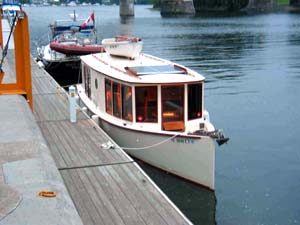
"Leah Gent"
The first boat I built was "Whippoorwill", a Wharram Tiki 26 catamaran. I launched it in Minneapolis, Minnesota, in 1989, and took it down the Mississippi river and Tenn-Tom Waterway, and then on to Marathon, Florida Keys. I cruised in company with My Parents on their Pilgrim III from Alma, Wisconsin to Punta Gorda, Florida. My intention was to sail on to the Bahamas, but that never happened. On that cruise, I fell in love with river cruising, but a sailboat was not the ideal boat to use for that.
After selling the cat, I designed and built a 26 foot river cruiser that was powered by a 9.9 hp Yamaha Four Stroke outboard. "Heart of Gold" was launched in Boonville, MO in the fall of 1997, and I took it to the Florida Keys, and then back up to Lacrosse, WI and then back down to Fort Myers Beach, Fl, Where I lived aboard for another Year and a half. "

Heart of Gold
I decided that I really liked the lifestyle, but I needed a bigger boat. What I needed was a permanent liveaboard home, with plenty of space and headroom. I wanted it to be as inexpensive as possible to build and run, but I also wanted classic styling.
I started out with a simple flat-bottomed sharpie hull. The advantages of a sharpie are mainly shallow draft and simple construction. There are numerous disadvantages, though. Sharpies pound in a head sea, and they have steering problems in some conditions. A long deep skeg will help solve some of the steering problems, but I wanted to retain the extreme shallow draft, so I used twin shallow skegs.
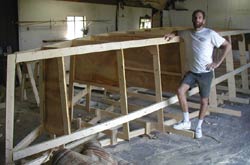 The most practical shape for this type of boat would be wall-sided (like Bolger's Sneakeasy design), but I decided that I would sacrifice some ease of construction for style. The bottom is 8' wide from about midships to the stern. The sides flare out from the bow toward midships, and then tumble home toward the stern, making a nice sweeping shearline. The most practical shape for this type of boat would be wall-sided (like Bolger's Sneakeasy design), but I decided that I would sacrifice some ease of construction for style. The bottom is 8' wide from about midships to the stern. The sides flare out from the bow toward midships, and then tumble home toward the stern, making a nice sweeping shearline.
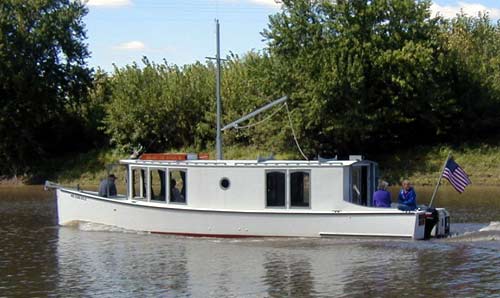
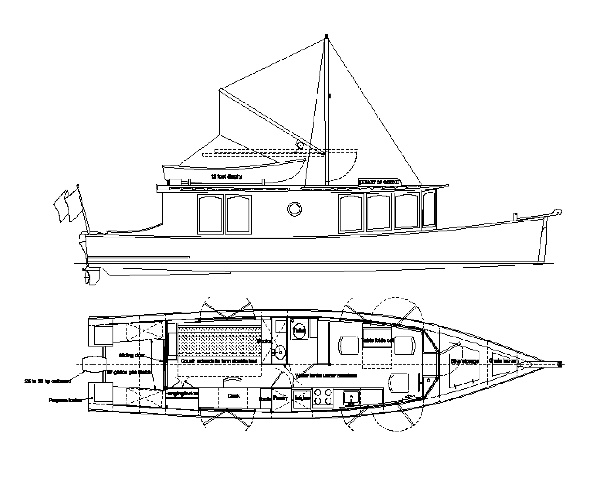
The cabin is a "street car" type, like the launches and water taxies of around 1900. There will be room on top for a nice 12' dinghy and plenty of solar panels. The mast will be easy to lower for bridges.
 The interior has at least 6'8" headroom throughout. Aft, there is a stateroom with a couch that converts to a 7' long double bed. Across from that is a large hanging locker and a desk. There is a large bookshelf forward of the bed, and also forward of the desk. Midships is a 4' by 4' head, with a composting toilet. The interior has at least 6'8" headroom throughout. Aft, there is a stateroom with a couch that converts to a 7' long double bed. Across from that is a large hanging locker and a desk. There is a large bookshelf forward of the bed, and also forward of the desk. Midships is a 4' by 4' head, with a composting toilet.
"Forward, there is an 8' galley, with a 18" wide pantry with sliding shelves. The forward cabin also has a drop-leaf table and a helm. There is enough floor space for a double air mattress for guests.
There are numerous opening windows, and a door leading to the sunken fordeck. Forward is a large hold for a full-size bicycle, and self-bailing chain locker under the foredeck.
Aft is a cockpit and moterwell for the outboard, and two 25 gallon gas tanks. Storage for propane tanks is beside the motor well.
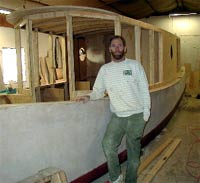
Construction is mainly plywood and epoxy. The bottom is one layer of fir tongue-and-groove flooring (from an old house) followed by two layers of plywood to finish 2" thick. The fir flooring is varnished and serves as the cabin sole.
The sides are two layers of 1/2" plywood. There are watertight bulkheads forward and aft of the cabin, and there are no underwater thru-hull fittings.
LOA 38' 9"
LWL 38'
BEAM 9'
DRAFT 9" (with motor and centerboard raised)
3' (with motor and centerboard down)
DISP 9,500 lb loaded
It cruises at 8 knots with the Mercury 25 four stroke Bigfoot, at 4,500 rpm, which is 1,000 rpm below wide open. I think it should go 10 or 11 knots with a 40 or 50 hp motor.
See Brad Indicott's Mark V39 "Leah Gent" project page:
http://bradsboat.tripod.com/
|