
Canoes & Kayaks
- Product
- Qty in Cart
- Quantity
- Price
- Subtotal
-

18' Outboard Motor Freight Canoe Plans
$100.00For those wanting a much bigger outboard motor canoe capable of having several fishing at once and which can also be used as a freight canoe on rivers and lakes, the 18' Outboard Motor Freight Canoe would certainly suit. She can take 6-8 adults or 4...$100.00 -

16' Hazelnut Clinker Canoe
$88.00The 16' Hazelnut is based on the 17' version but has been drawn up with the clinker/ply construction method in mind using a building jig and moulds to gain the plank shapes. She has 5 planks per side.The plank shapes and building details are also...$88.00 -
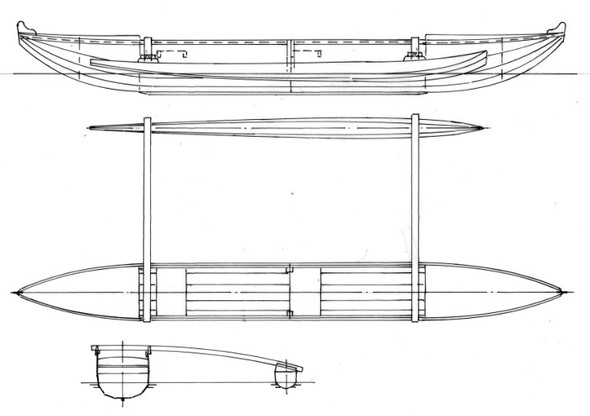
16' Koa Hawaiian Fishing Canoe
$115.00This design is a modern interpretation of the traditional Koa fishing canoes which were 'dugouts' and made from a single log. The hull has a narrow flat bottom with 4 planks per side - the top hull panel has some tumblehome in it to emulate the log shape...$115.00 -

14' Asymmetric Raven Plans
$61.00Based on our 14' Raven which is one of our most popular canoe designs, this asymmetric version is for single long distance use with plenty of capacity to carry camping gear and provisions. The asymmetric hull shape will make her excellent at tracking,...$61.00 -

14' Adirondack Guide Canoe
$74.00I am often asked to modify one of my stock designs to suit individual requirements and that is how the 14' Adirondack came about - this design is a development of the 12' x 39" Adirondack canoe (see earlier on this page) and is a roomy guide boat...$74.00 -
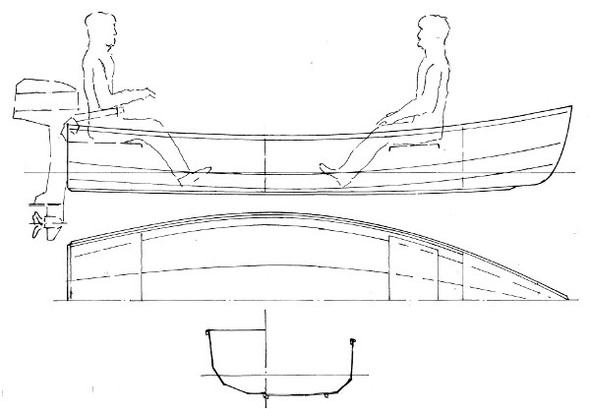
10' OUTBOARD MOTOR CANOE
$68.00This canoe is a shortened version of the original 12'6" Outboard motor canoe for a client who wanted a more compact design which would be easier to store. Stitch and tape construction is used to make her quick and easy to build with a low construction...$68.00 -
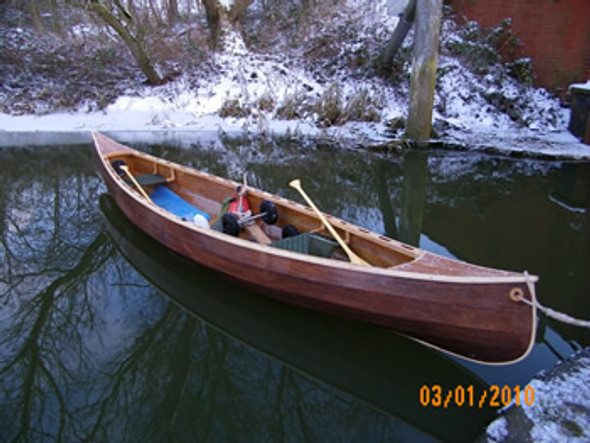
15'8" Fisher Prospector Plans
$68.00This is the Selway Fisher version of an old favourite - the Prospector type open canoe. The original Prospectors were originally designed in Canada and known as the "workhorse of the North". They had to have a good carrying capacity for all of the...$68.00 -

14' Peterborough Plans
$61.00This is a 14’ version of our larger Peterborough design but in this case we have gone for a design with 7 planks per side. She still uses the simple stitch and tape method of construction and has seats for 2 crew. Midships depth is 12 1/2” (0...$61.00 -

13'6" Big Kate Open Canoe Plans
$61.00The Little Kate has been a very popular design for those wanting a lightweight, easily portaged single canoe. I have been asked to use the lines of the original 27" beam version and extend it by 2' (0.61m) to 13'6". This produces a lightweight canoe,...$61.00 -

11' Kate Open Canoe Plans
$61.00Kate is similar in length to Little Kate but has a midship section which approaches that of the Christine (so you could look upon her as a shorter version of Christine). Kate has 5 planks per side. 11' Kate Particulars LOA 11' 3...$61.00 -

17' Prospector Open Canoe
$88.00We developed the hull panel shapes for a stretched version of the Fisher Prospector some time ago and now we have completed the set of drawings. She has the same 5 planks per side, generous rocker to the bottom and tumblehome in her topsides that the...$88.00 -

15'6" Beaver Canoe/Skiff Plans
$68.00The BEAVER is an ultra modern open canoe skiff using the latest methods of construction to make building time as short as possible. She has the same shape at both ends and each half of the boat is made in one piece of ply with simple darts cut into it...$68.00