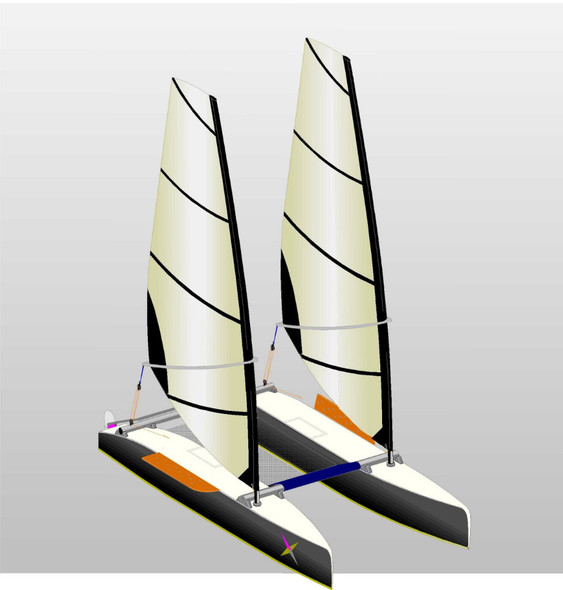
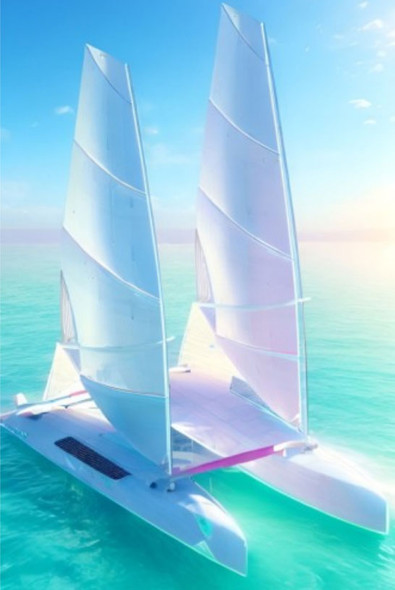
The A18-T project
is nearing completion in my shop with only the simple
construction of the amas and the final painting before
assembly. Testing will follow after that. I have a
plan to show her at the Vancouver Wooden Boat Show
in late August followed by the upcoming Lake Powell
Messabout in September.
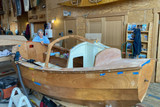
The pictures show the vaka hull so you can see the
shape of the multi-chine hull with hatches fore and
aft as well as the molded grooves for mounting of
the aka tubes.
(click images
to enlarge) |
The main compartment is teak trimmed with an instrument
dash section to accommodate a Garmin 276C in the center
and space for a standard bulkhead mount marine compass
on one side. The other side of the dash is for a digital
speed readout unit that is surface mounted. Above
the dash is a molded, spray deflection pod that serves
as a mount for a smoked Lexan visor over the instruments
as well as a mounting point for the leading edge of
the dodger.
The daggerboard trunk is built to accept a Hobie
Mirage drive unit. It also takes a convertible insert
that holds the high aspect ratio foil for sailing.
The amas and akas will be easily demountable along
with the rig and then the vaka hull can be used as
a canoe for quiet water paddling from the traditional
fore and aft seating positions. The outer sections
of aka tubes are storable in the hull.
The amas can also be connected to the shortened aka
tubes closer to the vaka hull. This allows the hull
to be used as a canoe form with a substantial set
of stabilizers. I saw this application as useful if
the boat were used with a small outboard for principal
power. A small, sporty power tri for fishing, birdwatching
or jetting around the harbor.
The seats in the conventional canoe positions are
fully adjustable up, down, fore and aft as well as
rake for individual comfort and trim. They can also
be quickly removed when the hatches are installed
and the boat is sailed from the tramp or central compartment.
The boat can also be sailed from these canoe seating
positions. All controls are led to the center compartment
and can be accessed from the aft position.

The boat can accept rigs up to and including those
from a Hobie 16 at 218 sq. ft., complete with trap
wires. The boat will also sail well with a 146 sq.
ft. Hobie 14 rig. The masts for either of these rigs
will mount to the forward aka tube. I designed the
A18 for these two rigs as they are plentiful in the
used market and are a forgiving, known rig for sail
makers as well as thousands of sailors worldwide.
The boat can also be equipped with a full dodger/bimini
cover complete with removable side curtains. Because
of the control locations and the Mirage drive potential,
this means the boat can be sailed and/or peddled comfortably
in lousy conditions with the owner staying dry and
comfortable.
The A18 will make for an excellent coastal cruiser
for a single person or a really fun weekend camp cruiser
for two. In setting out the design criteria, I was
looking for a boat that had a distinct performance
sailing component compared to the other sailing canoes
that I had done in the past. This is a decidedly fast
sail boat with a nod to its canoe potential.
The boat is 18 feet LOA, 15 feet BOA and draws six
inches with the board and/or Mirage up at a 750 lb.
displacement. All the hulls are built using S&G
marine ply for the hull surfaces (The vaka is 1/4"
and the amas are 1/8") and strip built decks
to get the flowing contours on top. The design allows
for a centerboard setup instead of the daggerboard/Mirage
trunk if the owner prefers that arrangement. In the
case of the centerboard, human powered aux propulsion
will be paddles.
My experience so far is that this will be a relatively
easy boat to build for someone who has constructed
a kayak or canoe already. I would not recommend the
project to a first time boat builder.
Inspiration for this boat came from a variety of
sources, all serious Watermen. Jim Brown spent a bit
of time through letters and on the phone with me a
few years ago and shared his insight freely and with
enormous grace. Jim Antrim has been more than a mentor
as I have "borrowed" concepts from his phenomenal
multihulls and he has made himself available for technical
and aesthetic inspiration. John Winters has pushed
the standard for modern canoe design and gave me some
powerful advice as to decision making when outlining
a design criteria. Steve Isaac of the Watertribe clearly
enunciated a concept for coastal exploring in boats
that were, at once, reachable for the common guy and
could also provide the right format for fulfilling
waterborne dreams.
I'd love to hear what you guys think of the concept
and potential.
Chris Ostlind
Chris@Wedgesail.com
|