|
A modular approach to SOT kayak sailing and paddling
Sit-On-Top (SOT) kayaks are easy boats on which to learn
to paddle. They have none of the “get inside the coffin
and drown” psychological identity that one finds in
the Sit-Inside boats and they’re amazingly adaptable
to a wide range of paddling activities. It also doesn’t
hurt that they are pretty straightforward boats to rotomold,
which makes them very cheap to produce in large numbers.
I didn’t envision just one boat for this niche in
the home-built kayak market. Instead, it came to me that
there would need to be at least three models that could
address the wide-ranging styles of boating interests in
this area of the kayak world. The result was a couple of
very clean, SOT models at 14’ and 16’ called
the Corona and the Back Bay. The third model was going to
be called the Wahoo, as it was specifically designed for
the folks who spend a lot of time fishing with their SOT’s.
I’ll get to the Wahoo in the next article for Duckworks.

As a canoe and kayak sailor and a guy who had just been
out for a test drive on the Hobie Island, which is based
on their 16’ SOT Adventure model, I wanted to offer
my own take on what makes for a truly fun and stylish, sailing
SOT kayak. The result was that a fully integrated system
of component parts was designed for the basic Back Bay.
This modular approach allows the Back Bay to go sailing
by simply adding a system of light weight, easily built
elements that quickly convert the SOT to a single aka sailing
boat called the Scorpion, OR a double aka sailing boat,
called the Doubloon.
The Corona and the Back Bay are virtually identical models,
save for their respective lengths. For the purposes of this
article, I’ll focus on the Back Bay version and all
the potential add-on systems I’ve incorporated in
the design.
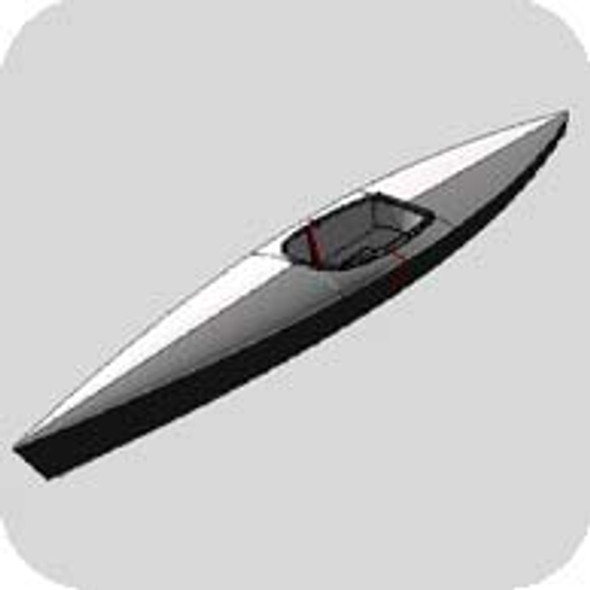
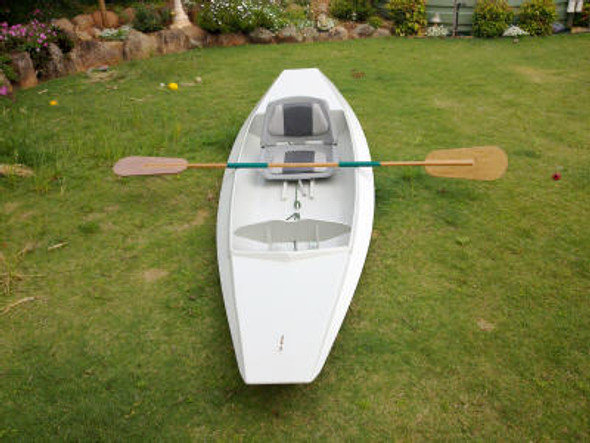
The Back Bay SOT kayak

Specifications: |
| Length overall |
- |
16' |
Beam overall main hull |
- |
28" |
Depth of hull max |
- |
12” |
Weight |
- |
48 lbs. or less |
Displacement |
- |
335 lbs. |
This boat is built in the S&G style of construction
in 4mm marine ply with 6 oz. plain weave fiberglass set
in epoxy on the inside and outside of the hull for full
laminate sandwich strength. The build process uses external
cradles as strongback supports, ensuring that the hull goes
together with minimum hassle when handling the rather slender
and longish hull panels. The boat is bulkheaded internally
at three key points. These bulkheads create not only integrated
strength in the design, but they also cleanly separate the
hull cavity into four unique volumes for gear storage and
watertight flotation.
The Back Bay can be configured with a large, open tank
well set aft of the cockpit, or built with a watertight
hatch cover for internal storage in a conventional kayak
style.
Scorpion Sailing SOT

Specifications: |
| Beam overall |
- |
10' |
Weight (est.) |
- |
90 lbs. |
Sail Area |
- |
56 sq. ft. |
Displacement |
- |
350 lbs. |
Draft (board down) |
- |
28" |
This is a Sit-On-Top design for fun sailing, paddling,
or Mirage peddling, as the builder desires. The sailing
daggerboard drops through an insert in the Mirage trunk.
(if the peddle function is chosen during construction) The
owner can omit the Mirage capability if so desired and a
simple slot for the daggerboard will substitute. Having
the aka gull wing form set well forward permits a full paddle
swing arc. This setup will allow the owner to power sail
in light air with both the paddle and the sail providing
thrust. It is also possible to offset the daggerboard trunk
and utilize the Mirage drive for a power sailing option.
The amas are positioned to optimize capsize resistance
when sailing off the wind and have sufficient buoyancy to
resist capsize with full sail up in a 20 knot breeze. The
amas do not touch the surface of the water at rest and provide
only minimal wetted surface drag when underway by paddle
or peddle.
The aft deck can be configured as a watertight hatch with
full access to the aft sections of the hull, OR a large,
diving tank well with self-draining ports. The cockpit is
fitted with self-drain ports under the seat as well as forward,
in addition to the daggerboard slot. There is a watertight
deck plate just forward of the seat, between the knees of
the sailor/paddler to provide secure storage for critical
items that may be needed on a routine basis. The foredeck
has a watertight hatch cover for bow storage needs.

The rig is a fully battened Dacron sail with two reef points
and a multi-section, self-supporting mast which steps into
a sealed mast socket in the hull. The mast and boom sections
can be aluminum or carbon, as budget permits. The sail choice
is open for the customer as long as it can be balanced with
the fixed positions for the mast and dagger board. The Cunningham
is run to the deck of the gull wing aka to keep the rig
on the boat in the event of a capsize.
With 56-sq. ft. of sail on a 90-pound boat, this will be
a decently speedy boat without being in over its head all
the time in a stiff breeze. I suggest two reef points in
the sail to allow for sailing in a wide variety of conditions.
This will be a wet boat at speed, yet there are no worries
at all for flooding and sinking save for a truly nasty trip
over a reef that shreds the entire underside of the craft.
The bow, cockpit and aft hull volumes are all independent,
sealed compartments, as are the ama volumes.
Reentry from a swimming session will be easy with a simple,
sling ladder much like those used by rock climbers, called
etriers.

Sliding foot pedals in the cockpit control the rudder.
The rudder flips-up when it encounters an underwater obstacle,
returning to the deployed position once past the obstruction.
The boat is constructed in a multichine, marine plywood
style with epoxy glass laminates inside and out in a stitch
and glue style. Stainless T-Nuts are embedded in the hull
deck surface from below to provide a secure set of mounting
points for the aka wing. The amas are held in place on the
aka tips by large bungees and a notched lock system. This
system provides for quick setups on the beach.
You just fit the aka to the foredeck, insert four, 1/4"
threaded stainless screws with comfortable, knobbed grips
and screw down the aka wing. The amas slip onto the ends
of the aka and you lift the pair of 3/8" bungees up
and over two raised hooks on the aka ends to secure the
ama in place.
Doubloon Sailing SOT

The Doubloon is the second variation on the central SOT
theme of this group of boats. In this design, I am looking
to provide a more expansive utility application for the
base, Back Bay SOT version. The Doubloon is essentially
a solo craft and it carries the same, 56 sq. ft. sail, but
the overall potential of the boat is expanded through the
use of dual akas and full side trampolines.
The akas on the Doubloon are spaced to allow for a full
paddle stroke with the boat setup as a trimaran. There are
two sections of tubing that span the opening fore and aft
between the akas from which the tramp is mounted. The trampolines
are designed to roll-up on the outer tube section, much
like a window shade and they are deployed by an endless
loop of light halyard line. With the tramps fully deployed,
the inner tube section lifts up and over a holding pin in
the aka and the sailor applies as much tension to the tramp
as he feels he needs by hauling-in the endless loop line
and cleating it off. If a paddling session is desired, he
simply pops the jam cleat and pulls the line to roll-up
the tramp on the outer tube section. This procedure applies
for both port and starboard tramps.
Like the Scorpion, the Doubloon can be built to utilize
a Mirage drive in the center well and the need to roll-up
the tramps for paddling is essentially negated, (though
it is nice to have the option once in awhile as Mirage drives
are hard to maneuver in tight places)
The aka beams are held to the deck of the Back Bay hull
with the same, threaded knob strategy for quick setup and
takedown times. Similarly, the amas are held to the aka
ends with hefty bungee cords for the simplicity of use.
There’s another, rather invisible, benefit to using
the bungee cords for ama mounting. Because they are being
held in place through a fairly dynamic hold-down system,
the amas can move about, ever so slightly, while underway.
This allows the amas to have some structural “give”
and the result is that the banging and thrashing that is
typically experienced by the ama, is somewhat dissipated
through the flex of the joining system.
The Doubloon configuration allows the sailor/paddler/peddler
to bring along extra gear, which can be lashed to the tramps
in waterproof bags. They can also take along kids, or perhaps
someone special, who could lounge out on the tramp surface
while lazily sailing along for a sunset cruise on a warm
summer evening.
All in all, I think the Back Bay SOT should be a really
fun boat to own for warm water/warm weather boating adventures.
It has the capacity to carry enough gear for several days
out on the water. When rigged with a sailing system of your
choice, it can also cover some pretty good distances if
the winds are favorable. Plans for this boat and all its
variations will be available from Duckworks.
Chris Ostlind
Lunada Design
Chris@Wedgesail.com
|