
Handy Punt Plans PDF

- SKU:
- OZ-HANDYPUNT-ID
- Availability:
- Available for download after checkout

Description
For Handy Punt printed plans, click HERE
Simple to Build
Stable
Built in Buoyancy tanks
Excellent Utility Boat for Caravanning.
Comprehensive Plan Pack with step by step instructions and many illustrations

Background:
The Handy Punt was my third design. It was derived largely from the 8ft (2.4m) Phil Bolger designed "Skimmer" - yet another example of Bolger's Genius. (Skimmer is in Dynamite Payson's book "Build the New Instant Boats")
The advantage of the "Handy Punt" is purely in terms of load carrying capacity. She will carry a family of four quite happily.
With all that built-in buoyancy there is quite a good margin of safety, but it is important to remember that punts really are suited to lake, river and estuary waters.
The Punt comes out of 4 sheets of ply. One of the fun aspects was the amazing lack of ply wastage. Probably less than 5% of the ply is not used in the boat. An interesting corollary of this is that it is difficult to stretch her in length or beam without increasing the amount of ply needed substantially.

Powering:
When I drew the plans up I made the transom strong enough to handle a 15hp outboard. The first few launched used modest powerplants of 6 to 8hp which she handles very nicely. Lower power (5hp) is OK if there is only one person and a light payload - maybe a child and some fishing gear and the intention is to chug along.
Given 8 hp the punt moves along quickly with two people and gear and still moves well with three . 10hp is better.
The report I have heard of the 15hp is that one or two up it is a very fast ride - lots of speed - lots of spray.

Performance and handling:
The punt is one of the most common utility boats. They are fast under moderate power in reasonably smooth water, have a huge initial stability and good weight carrying ability.
The usual problem with punts is weight of the bottom construction. The Handy punt avoids this by having large external bottom runners which distributes the loads into the seat faces. The epoxy technology allows this approach as the boat is effectively glued into one piece. Not my idea but stolen from the original boat
The Handy Punt will lift up onto the bottom runners when lightly laden at higher speeds, this reduces the wetted area for a reduction in drag, and more speed.
Weight has a huge affect on speed and general performance. The weight of 110 lbs would be acheivable using Gaboon Plywood which is 30% lighter than most other plywoods.

Building:
Building is instant style with all components prefabricated out on the flat. The sides are then set up with the bulkheads and transom between.
The boat is now turned over and the seat tops and gunwale framing fitted. Finally the boat is inverted again and the bottom and bottom runners are now fitted. They work in conjunction with the frames inside the boat to provide a very stiff structure.
Here are pictures of the building process


Click here to download a PDF materials list (metric)
Click here to download a PDF timber list (imperial)
- Length - 11'6" (3.11m)
- Beam - 4' 2" (1.62m)
- Weight - 100lbs (46kg) - Gaboon (Okoume) Ply
- Power - 6 to 15hp
Related Products

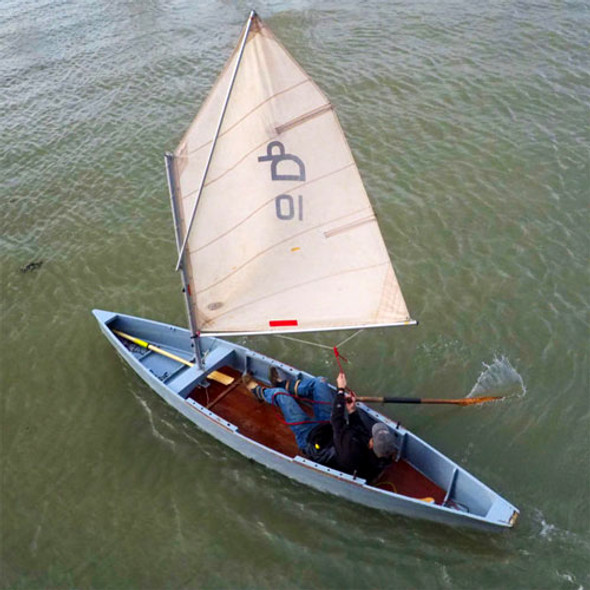
West Mersea Duck Punt PDF Free Plans

24' Cambridge Punt Plans

16' Cambridge Punt Plans
